Categories
Saturday SXSW '09

Change V2 – Lawrence Lessig

Saturday, March 14th at 11:30 AM
Presenter: Lawrence Lessig – Stanford Law School

(Lessig is a great speaker, but hard to keep up with when taking notes. You can view his presentation and slides here: http://blip.tv/file/1889038)

Trust

lonely planet – reliable guide – don’t accept money/discounts for coverage. Money doesn’t make what they say false, just breeds mistrust.

Wikipedia does NOT accept ads. They leave much money on the table. They care how they look and have trust – money doesn’t make what they say false, just breeds mistrust

Mistrust

Ulterior motives – child vaccines – parents don’t trust health professionals. Drug paid to have negative reviews removed. This produces doubts by conceived conflicts. Many times doctors can get $$ from drug companies fueling mistrust. which hurts children.

“Classic Tobacco Science” – corrupted science. this weakens trust we have in science.

“Maxed Out” movie – credit card dept. Credit card dept cannot go away from bankruptcy. Hilary Clinton got it to go away at first – then flipped in 2001 when a senator (after getting money/donations from drug companies) $140,000. Will people trust her after they hear about the money? Even if she didn’t do anything.

Money is NOT evil. Money poisons trust because we begin to believe that decisions are potentially made for some other reason.

Politicians and Doctors say it’s crazy to think that these things change their thinking on an issue (or drug).

Sonny Bono Copyright Term Extension Act – +20 years on copyright. Does this advance public good?

Easy public policy questions are answered wrong by our government.
Why?
Are they guided by something other than reason?

Dependencies erode trust. Founding fathers wanted INdependence. Congress has always had corruption issues. Bribery was ok until 1853.

It isn’t the same today. Now is “good souls corruption.”

Money buys results in Congress – nobody is stealing or cheating or bribing, but our faith is still destroyed in this institution. Money secures tenure – reelection. What they do isn’t guided by what it does to their constituents but rather how it hurts/helps the money they raise for reelection.

Congress is a farm league for K street. Business model of DC is work for 4-5 years then spin out to K street as a lobbyist.

The problem is not big government or deregulation – the problem is loss of trust. Last year only 9% thought congress has done or is doing a good job. Now only 18% think this. We can’t/won’t trust this institution.

How do we change this dependency? Restore trust and remove the improper dependencies. Make sure decisions are being made for the right reasons.

ONLY way to do this is to citizens funding of the nations elections. Congress can only get money from citizens directly (capped at 1-200/person). Or only from a central location.

Strike 4 Change (strike4change.org). Demonstrate how much candidates are losing from donations not coming in now. We have to change how congress is funded.

This is just the first problem, the dependency is the first problem. It may not be the most important problem, but his needs to be solved first. Something needs to be done to solve this problem – WE need to do something. We can afford to do something about this.

http://change-congress.org

Panel Podcast (mp3)

Categories
Saturday SXSW '09

The 7 Rules for Great Web Application Design

Saturday, March 14th at 10:00 AM
Presenter: Robert Hoekman Jr – Miskeeto LLC

  • (actually more than 7 rules)
    You want your users to feel like a lion, and not feel frustrated.
  • Unfortunately, the web sucks for making users feel like lions.
  • Sites that work well support innate human behavior (you don’t buy a drill to drill, you buy a drill to make a hole).
  • The number one goal for people using your site is to get away from your site.

1. Understand your users, and then ignore them.

  • Who would buy a low carb version of a cheeseburger (they look the same, taste the same, smell the same, cost the same)? People said they would buy it, so they created and tried to sell the sandwich, but it did NOT sell. Why? People are bad at predicting their own behavior.
  • Find out how users ACTUALLY act by observing and not going off of what they say they’ll do. Ignore what they say. If they tell you, they might be wrong.
  • Example: basecamp.com – it focuses on the real human behaviors, and not just answers to questions.

2. Build only what’s absolutely necessary

  • What does something absolutely need to do? Focus on those items
  • Example: senduit.com (file upload/download service) there is no extra stuff in it.
  • When people buy a cell phone, they don’t use many of the features on the phone that they’re paying for.
  • It’s not about simplicity, it’s about clarity and usable/understandable.

3. Support user’s mental model – drag a fie to trash can to delete it.

People don’t think like computers – look at DOS delete model vs. the current delete model.

4. Turn beginners into intermediates immediately

  • Don’t make users feel stupid – they will leave. Make things easier, and make them feel smart – they will stick around.
  • Example: Old WordPress.com homepage was very difficult to sign up for an account. They got actual phone calls asking how to sign up. It took 10 minutes to add a larger more prominent sign up button. Conversions went up 12-14%. All the change did was help users feel smart

5, Prevent  Errors (and handle them gracefully)

  • Policy emergency system harder to use – should be a BIG RED BUTTON. This makes it less likely someone will make a mistake.
  • Make it easy to fix and change things to prevent errors.
  • Example: Backpack.com – you can’t make errors – there are no error messages.
  • Eliminate the possibility of errors – find errors and see if you can prevent them (or at least provide a helpful nice error message).

6. Design for uniformity consistency and meaning

  • Squidoo.com – people would happen across the site from a search and not know where they were or why they’re there.
  • Clean things up and make the experience more understandable.
  • Improve the explainablity of the site so you know where you land and why/what you can do there.

7. Reduce Reduce Reduce (and refine)

  • Store sign from "We Sell Fresh Here" to "Fresh Fish Sold" to "Fresh Fish" to "Fish" to No sign at all. It was obvious what was happening, and a sign wasn’t necessary. All clues for what happened in the store were obvious.
  • Reduce the signal to noise ratio.
Categories
SXSW '09

Cnet Buzz Out Loud Podcast Taping

Friday, March 13th at 05:00 PM
Presenters:
Tom Merritt – CNET
Jason Howell – CNET
Natali Del Conte – CNET

For my last panel of the day, I went to see a taping of one of my favorite podcasts, Buzz Out Loud from CNET. It was fun to actually see a show being put together since I’ve only listened to the audio version before. All three hosts were there, but were joined by Caroline McCarthy, Wine Library TV’s Gary Vaynerchuk, and The Onion’s Baratunde Thurston. If you listen to the podcast, you might hear me laughing or clapping along with the show.

Categories
SXSW '08

Buzz Out Loud Podcast Taping

Friday, 13 March 2009 at 5:00PM

Panel for the Buzz Out Loud podcast

Panel for the Buzz Out Loud podcast

Link to the podcast at cnet.

Categories
SXSW '08

Oooh, That’s Clever! (Unnatural Experiments in Web Design)

Friday, 13 March 2009 at 3:30PM
Presenter:  Paul Annett - Clearleft Ltd

Basically, this presentation focused on the power of Easter eggs in design and their power to please users. When people see the existence of something hidden or the trick of the trick, they want to share with everyone. He gives the example of a YouTube vid he posted. That is a secret to web design - adding clever bits to design. They made Silverback and the meme over the faux parallax is an example of this.

Other examples:

Kano model of customer satisfaction:  [if I find Paul Annett's slides, I will put the graphic here. Until then, feed on this.]

It is often up to designer to create the excitement needs. This that cause excitement this year will be performance or basic in the future.

“It is not enough that we build products that function, that are understandable and usable - we als need to build products that bring joy and excitement, pleasure and fun, and yes, beauty, to people’s lives.” - Don Norman

Other references made during presentation:

Categories
Friday SXSW '09

Oooh, That’s Clever! (Unnatural Experiments in Web Design)

Friday, March 13th at 03:30 PM
Presenter: Paul Annett – Clearleft Ltd

Product:

  • Clearleft Ltd created Silverbackapp.com. Before the application was even released, people noticed the intro site had 3D vines on it. Users thought they were on to something and tweeted it, giving a bump in traffic. They thought they’d found a little gem in the site that added value.
  • FedEx logo arrow between E and X. When it was pointed out, it is an ah-ha moment that adds value to the design.
  • Toblerone bar has a bear on the mountain on the package – again, it is somewhat hidden and adds a little something to the logo adding value.
  • Truce Vodka and Aerosmith have logos that can be flipped over and have the same look (ambigram).
  • All this hidden stuff in logos make you want to look for more. Disney films, and Disney World have hidden mickey heads all over.
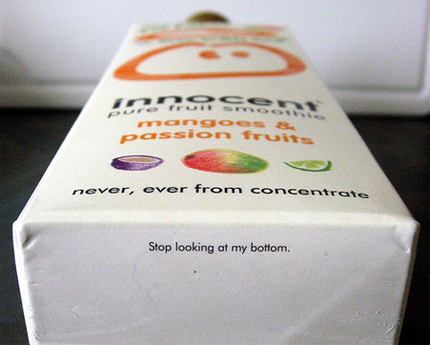
  • Innocent Smoothies says “stops looking at my bottom” or “Boo” on the bottom of the carton. Small hidden messages add delight to products and designs.
  • Moo Stickers packages have hidden messages inside the packages ripped apart “ooo! you broke me”
  • Apple mighty mouse shows a little mouse in the red light at the bottom.
  • Firefox, typing about:mozilla gets a message from “The Book of Mozilla” which changes from version to version.

Web:

  • Silverbackapp.com layered vine effect was accomplished with three vine images placed in front of each other and offset. When the screen is resize you have a 3D effect.
  • TweetOne uses the same effect with a hidden item.
  • Tweetquency does the same 3D effect.
  • Zoetrope is created with the web layer effect as well, making an animation of a horse.
  • Ho ho ho Hat and beard on flickr. When you added a note with that comment, a hat and beard shows up on photos
  • Google Moon zooming in showed the moon is made of cheese.
  • dconstruct.org has a style switcher and specifically hid certain pieces of the site to gain interest.
  • Kyan media has a little worm at the bottom hiding a full lab underground
  • Modernista is simply a nav menu sitting on top of other websites, starting with Wikipedia, them moving to their other stuff on other sites. (skittles.com stole their idea recently).
  • Able Design shows the scroll behind the logo.
  • WeBleedDesign drips paint down the page through the entire site.
  • Youtube video for Wario and Apple Yahoo video for iTouch moves the rest of page around – breaking things we’re used to.

The effects of these delighters are explained by the Kano Model of customer satisfaction. Horizontal axis is the quality of execution. The vertical axis is how happy the customer is. The diagonal axis is the performance needs of the customer. Second diagonal axis is the basic needs – what a customer takes for granted. Web: it simply needs to work, if it doesn’t, you’re disappointed, but if it does work, it is what you expect to happen. Third diagonal is excitement needs. In a hotel is free wifi, or a fun hidden little trick on a website fits this. This changes over time, if you were excited about free wifi last year, this year it becomes an expectation

It’s not enough that we build products that function that are understandable and usable we also need to build products that are useful to peoples lives.

Categories
Friday SXSW '09

My Boss Doesn’t Get It – Championing Social Media to “the Man”

Friday, March 13th at 02:00 PM
Presenters: 
Miles Sims – Small World Labs
Peter Kim – Dachis Corporation
Michael Wilson – Small World Labs
Rebecca Caroe – CreativeAgencySecrets.com
Christian Caldwell – Small World Labs/American Heart Association

When pitching, "the man" is the person with some sort of budget authority.

Why is it going to make sense?
How much does it depend on standard ROI? There is a measurable return of some sort. Reach is probably the biggest metric that is achievable. It can internally include the entire organization, and not just communications to get the messages out.

How is ROI Demonstrated?
6 weeks to create a plan to present to the board. Again, the important metric is "reach." Where is the value you want for your organization? It isn’t always in dollars, or concrete. This is what can drive other metrics though. Honestly, you can make an ROI say anything.

What Metrics?
First, what areas need it? Departments? It can be a way marketing/communications and IT can come together to save expenses. It can help with customer retention, employee retention and support.

Non-financial Considerations

  • Many times the questions come after it’s been out.
  • How does this help my customers?
  • What dedicated resources can we (the company) put towards this?
  • How can we show small successes?
  • What is the company culture? Can you handle loss of control (especially negative)?

What about Legal?

  • Guidelines: Don’t be stupid! (see MS blogging policy)
  • Legal wants to reduce all risk to zero – so there is a balance.

How do you get executive buy-in?

  • Some are under the radar
  • You can get some to buy-in and help with the rest of the company
  • Helps if the competition is doing it

There are many misconceptions out there, getting people educated is important to kill the misconceptions early on.

Questions:

What do you do when social media creates a culture change or it requires one to be effective?
-Show small successes and demonstrate the changed culture.
-Learn from failures – it helps if others see what doesn’t work.

When championing a social media project ho do you pitch?
-Play to the psychology you’re pitching to
-Find out individual motivations and pitch to appropriate groups.

Success/Failures?
-When you open it up, make sure you have reasons to handle the influx (many videos coming in at once needing review before going up).
-Sometimes recruiting the worst curmudgeons and find out what interests them, then find the best way to get that information out there (possibly through social marketing, but ease them into it).

How do you ensure projects are successful?
-Ongoing evolution – this isn’t a short term game – to change culture
-Build communities and cultures and have/support ongoing conversation.
-"If you can measure it, you can manage it" – set expectations at the beginning

Top Challenges to get approval?
-be realistic, keep it simple, show the business value

Top way to ensure success?
-good planning – who you want to reach, tell results back to everyone, build a culture in the community and monitor it – what are the metrics – define them up front.

What if "The Man" is corporate communications?
-Find their peer group, and show other are doing it (subtle).

Aside from money, what demonstrates success?
-recruiting new prospects details (valuable
-speed of research using the crowd
-Money IS the bottom line

Categories
SXSW '08

Everything You Know About Web Design Is Wrong

Friday, 13 March 2009 at 2:00PM
Presenter:  Dan Willis - Sapient

Making the argument that the Harry Potter movie site is everything that is wrong with web design. Why? They hide the web native stuff. Everything else is basically print magazine stuff regurgitated for the web- “Print in Disguise”. Headlines are a commodity that lead to linear text. Many newspapers have not realized how to exploit the web-native features. How can your website exploit the web and not just be a print brochure. We still treat web design as print design.

This happened with the transition from still to motion photography. Technologists create the content until artists catch-up. He used Birth of a Nation (1915) by D.W. Griffith as an example of using the techniques developed before in a new way (e.g., cross-cutting is much more effective that transitions in live theater). Hitchcock, for example, takes the close-up and pushes into emotion. Example:  Bird’s-eye view used in Fargo.

“One plus one equals three”, or take some of these elements and combine them to create more:

  • Random voyeurism
    Flickrvision and Found Magazine. We like to look at people vo
  • Self-aware (but controllable) content
    The content is meta-tagged and aware of itself in many different ways - just as referenced in Ambient Findability. Data/content grows beyond the intended purpose of the creator.
  • User-created content
    Fighting the user for control causes them to rebel. Forcing them down paths is problematic because they will rebel.
  • Ambient awareness
    Example:  micro-blogging. Over time, something like Twitter allows us to know others in a way we did not before. Each tweet is a dot in a more sophisticated image.
  • Experiential content
    Basically, content is still king, but today content is more than the text and images. Interactive experiences augment the content now and this is the future of what designers will need to create, but the designer needs to share space with the user.

How can we overcome print-in-disguise web sites? Hotel example:  Use webcams in the hotel lobby (voyeurism and ambient awareness). Pillow choices linked to sleep research and customer experiences, concierge is expert on good sleep, etc.

In the context of news, metadata links parts of stories so they can be reused. Don’t pollute too many pages with dynamic headlines because you can. Old design, print design needs to evolve and extinction is part of evolution.

Design solves problems and the visual design of the web can’t be answering the same questions as print design. We have, traditionally, compartmentalized our design (information arch, interaction, visual, etc.) like a TV dinner tray. We need to look at it like jambalaya and mix it all together. This begs for a see-saw implementation where everyone is involved in the party, but experts need to know their area of expertise and acquiesce to others, too.

  • Organize cross-disc teams; exploit and protect expertise
  • Design for specific users and their needs
  • Embrace your ignorance. We have not figured out the web, yet.
  • Don’t be distracted by business models that don’t begin and end with the user.
  • Don’t be distracted by technology.
  • Don’t be distracted by failure. Ideally you will fail quickly if it happens and learn from it. Move on.

References made during presentation:

Categories
General SXSW '08

SXSW 2008 Notes Table of Contents

Tuesday 3.11.08

Monday 3.10.08

Sunday 3.9.08

Saturday 3.8.08

Friday 3.7.08

Categories
SXSW '08

SXSW2008 notes – FM 2.0: The Future of Internet Radio

Tuesday, 11 March 2008 - 5:00PM

Abstract:
With the recent rate hikes impacting Internet radio, only the big guys benefit. Or do they? Will Internet radio look and sound like FM in the next five years? If so, how can the little guys survive? And, considering the challenges and costs, why would they even want to? This session will explore the positive and negative aspects of entering and staying in the Internet radio space, discuss how to make independent Internet radio work financially, and provide expert opinion on the future of Internet radio.

David Hyman (Moderator) - CEO, MOG Inc
Nancy Miller - Sr Editor, Wired Magazine
Anil Dewan - Dir of New Media, KCRW Radio
Tom Conrad - CTO, Pandora
Anu Kirk - Dir of Product Mgmt/Rhapsody, Rhapsody America LLC

Conrad: They are focused upon the move from broadcast to unicast of stations that understand what you want to listen to.

Kirk: There are many value addeds: album art, bilocation, artist info, xml data…

Conrad: There are three ways to look at matching music to a person’s taste…
Quantatative metadata - metadata about the beats and data of the songs
Qualitative data - genre, editorial voice
Social or collaborative systems reveal linkages
Pandora has moved away from solely rely on the music genome and now a combo of all three.

Kirk: It turns out that many people like a tastemaker/DJ - like KCRW.

Dewan: How do we use tech to do radio better? Create interactions. We are Old World meets New Wolrd while keeping curation and building this up with technology.

Conrad: There is nowhere to go to find out about what is most popular. The focus is not pushing but leaving the site a blank slate for the user. We think of ourselves of radio. Although terrestrial radio may have screwed up, there are may things that worked about it: simplicity, community, serendipity and repetition is not all bad. People like what they have heard before.

Kirk: What is different between that and a CD changer?

Dewan: Each DJ does not have playlists. they create it from scratch.

Kirk: DJs vs. robots both come out to 80% in the long run. [Me: I think this is a specious example, the ease with which I can switch up a station on demand with Pandora precludes the sameness of DJ vs. robots. It is harder to switch to another good DJ whereas on Pandora I can pull from dozens of stations.]

When will the reality of ubiquitous broadband give us streaming radio?
3G providers are scared that one or two users can drown a cell tower with streaming radio.